
What You Need to Know About Moon Cactus Indoor Care
Moon cactus indoor care is simpler than it looks — but there’s one thing most owners don’t know that causes their plant to die early.
Here’s a quick summary of what your moon cactus needs:
| Care Factor | What to Do |
|---|---|
| Light | Bright indirect light; filtered south-facing window |
| Watering | Every 1-2 weeks in summer; let soil dry completely between waterings |
| Soil | Well-draining cactus mix with perlite or coarse sand |
| Temperature | 65-80°F (18-26°C); never below 50°F |
| Humidity | Low; 40-60% is ideal |
| Fertilizing | Diluted cactus fertilizer every 4-8 weeks in spring and summer only |
| Repotting | Every 3-4 years in a slightly larger pot with drainage |
That colorful ball on top? It’s actually two cacti fused together.
The bright red, yellow, orange, or pink top — called the scion — is a mutant form of Gymnocalycium mihanovichii that produces zero chlorophyll. That means it cannot feed itself. It survives entirely by being grafted onto a green base cactus, usually a dragon fruit cactus (Hylocereus undatus), which does all the photosynthesizing for both.
This is exactly why moon cacti have a reputation for being tricky to keep alive long-term. Most last only 1 to 3 years indoors. With excellent care, some reach 5 years. The top often fails before the base does — but that doesn’t mean you have to start over.
This guide covers everything you need to keep both halves of your moon cactus healthy, and what to do when the graft starts to fail.
Understanding Moon Cactus Indoor Care and the Grafting Process
To master moon cactus indoor care, we first have to understand that we are looking at a “Frankenstein” of the plant world. These vibrant moon cacti are not naturally occurring species; they are man-made hybrids created through a process called grafting.
The top portion, often referred to as the “Hibotan” cactus, is a mutated version of Gymnocalycium mihanovichii. In the wild, these plants are grayish-green, but a genetic mutation discovered in the early 20th century resulted in specimens that lacked chlorophyll entirely. Without chlorophyll, the plant cannot convert sunlight into energy. To keep these colorful mutants alive, growers graft them onto a hardy, green rootstock.
The most common rootstock is the dragon fruit cactus (Hylocereus undatus), though you may also see them on Peruvian apple or golden torch cacti. This green base acts as the “lungs” and “stomach” of the plant, providing all the nutrients the colorful top needs to survive. Because the two plants often grow at different rates, the graft union—the physical point where they meet—is the most delicate part of the plant. If you’re interested in other unique varieties, you might want to explore some unique-succulents-to-grow-at-home to see how they compare.
Essential Environment: Light, Temperature, and Humidity
Creating the right “home” for your moon cactus is the first step in ensuring its longevity. Since this plant is actually two different species, we have to find a middle ground that satisfies both.
The ideal temperature for moon cactus indoor care falls between 65°F and 80°F (18-26°C). During the winter, they can tolerate slightly cooler temperatures, but they should never be exposed to anything below 50°F (10°C). If you keep your home at a comfortable human temperature, your moon cactus will likely be happy too.
Humidity is another factor to watch. While many tropical plants love a steamy bathroom, moon cacti prefer the drier air of a typical living room. Aim for 40-60% humidity. High humidity combined with low light is a recipe for fungal issues and rot at the graft union. For more broad advice on setting up your space, check out our guide on sunlight-requirements-for-indoor-succulents.
Optimizing Light for Moon Cactus Indoor Care
Light is where many growers accidentally harm their plants. The colorful top of the moon cactus is actually quite sensitive to direct sunlight. Because it lacks the protective chlorophyll that helps other plants process intense UV rays, it can sunburn easily.
We recommend placing your plant in bright, indirect light. A south-facing window with a sheer curtain is perfect. This provides the “filtered sun” that mimics the dappled shade moon cacti receive in their native South American habitats.
Signs your light isn’t quite right:
- Sunburn: If the colorful top starts to look bleached, white, or develops brown, crispy patches, it’s getting too much direct sun.
- Fading Colors: If that vibrant red or neon pink starts to look dull or turns a muddy green/brown, it likely needs more light.
- Stretching (Etiolation): If the green base starts to grow very thin and tall, or if it begins to lean aggressively toward the window, it’s “reaching” for more sun.
To keep the plant growing straight, we suggest rotating the pot a quarter-turn every two weeks. For a deeper dive into lighting nuances, see our article on sunlight-requirements-for-indoor-succulents-2.
Watering and Feeding Your Grafted Cactus
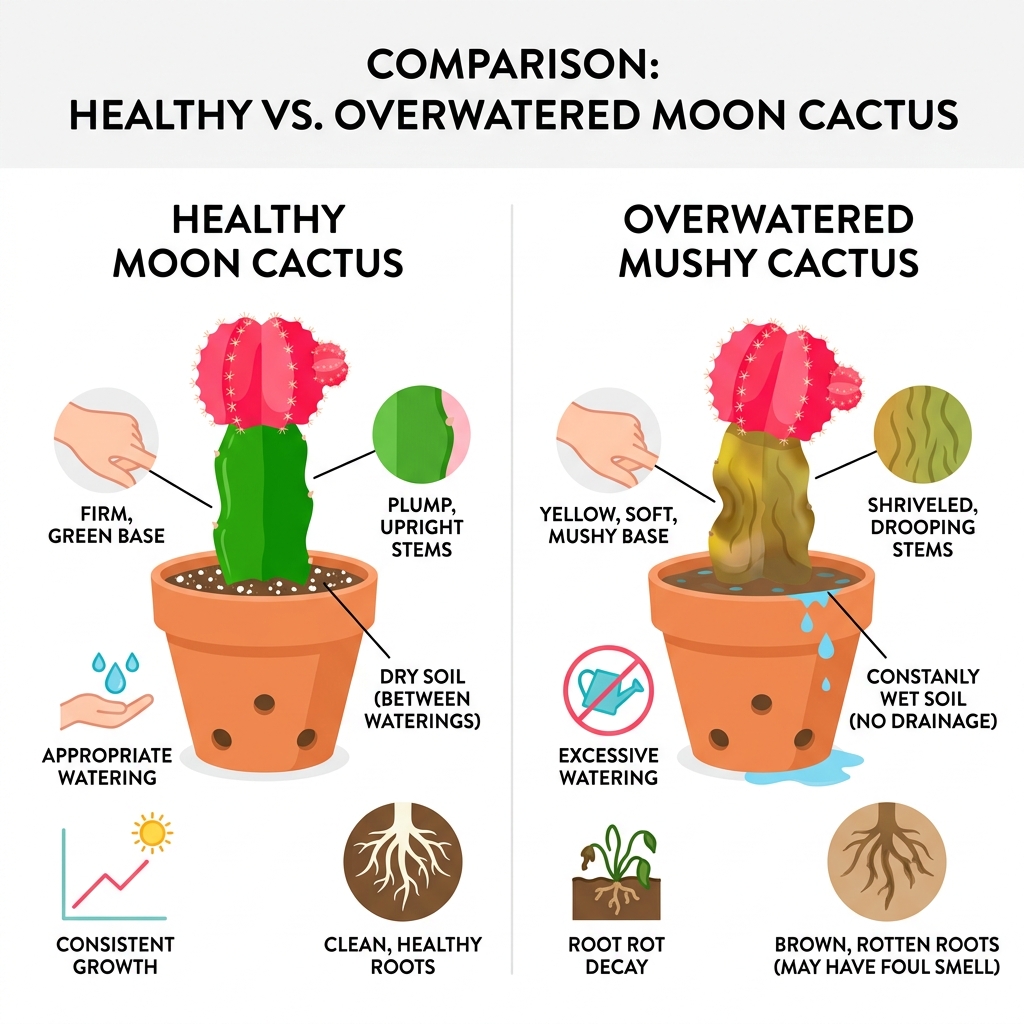
Watering is perhaps the most critical part of moon cactus indoor care. These plants are extremely drought-tolerant, but they are highly susceptible to root rot if left in standing water.
We use the “soak and dry” method. This means you should water the soil thoroughly until water runs out of the drainage holes at the bottom of the pot. Then, wait until the soil is completely dry all the way to the bottom before watering again. In a typical indoor environment, this usually means watering every 1-2 weeks during the spring and summer.
| Season | Watering Frequency | Fertilizing |
|---|---|---|
| Spring/Summer | Every 7-14 days (when soil is dry) | Once a month (diluted) |
| Fall/Winter | Every 3-6 weeks (minimal) | None |
During the winter months, the plant enters a period of dormancy. Its metabolism slows down, and it requires much less water. You may only need to water once a month, or even just mist the soil surface occasionally. Always check the soil moisture with your finger or a wooden skewer before adding water. You can find more details on setting up a routine in our indoor-succulent-watering-schedule.
When it comes to feeding, moon cacti aren’t heavy eaters. We recommend using a fertilizer specifically formulated for cacti and succulents. Apply it at half-strength once a month during the growing season (April through September). Never fertilize in the winter, as this can cause weak, spindly growth. Learn the specifics of nutrient balance in how-to-fertilize-succulents-indoors.
Signs of Improper Moon Cactus Indoor Care: Overwatering vs Underwatering
Knowing how to read your plant’s “body language” can save its life.
Overwatering Signs: This is the number one killer of moon cacti. If the green base becomes yellow, soft, or mushy, you are likely dealing with root rot. In severe cases, the plant might even develop a foul smell. If you catch it early, you might be able to save it by following our how-to-revive-overwatered-succulents-an-informative-guide.
Underwatering Signs: If the skin of the cactus looks wrinkled or puckered, and the pot feels unusually light, your plant is thirsty. While moon cacti can handle a bit of drought, prolonged dryness will cause the plant to shrivel and lose its vibrant color.
Potting, Soil, and Long-Term Maintenance
Choosing the right container and medium is essential for successful moon cactus indoor care. We always recommend using terracotta or ceramic pots with at least one large drainage hole. Terracotta is porous, which helps excess moisture evaporate from the soil, reducing the risk of rot.
The soil must be well-draining. A standard potting mix holds too much water and will eventually drown your cactus. We suggest a mix of:
- 3 parts potting soil
- 3 parts coarse sand or poultry grit
- 1 part perlite or pumice
For more on choosing the right substrate, see best-soil-for-indoor-succulents.
When to Repot
Moon cacti are slow growers and don’t need frequent repotting. Generally, every 3-4 years is sufficient. The best time to repot is in the late winter or early spring just as the growing season begins. When you do repot, choose a container that is only one size larger (about 1 inch wider) than the current one. If the pot is too large, the excess soil will stay wet for too long, leading to the problems we discussed earlier. Follow our repotting-indoor-succulents-step-by-step for a fail-proof transition.
Troubleshooting Common Problems and Pests
Even with the best moon cactus indoor care, pests can sometimes find their way in.
1. Mealybugs: These look like tiny bits of white cotton hiding in the crevices of the cactus or at the graft union. They suck the sap from the plant and can quickly weaken it.
- Fix: Use a Q-tip dipped in isopropyl alcohol to dab them away. For larger infestations, neem oil is an excellent organic treatment.
2. Spider Mites: These are nearly invisible but leave fine webbing between the spines. They thrive in dry, dusty conditions.
- Fix: Wipe the plant down with a damp cloth and increase the humidity slightly, or use an insecticidal soap.
3. Scale: These look like small, hard brown bumps on the skin of the cactus.
- Fix: They can be gently scraped off with a fingernail or treated with alcohol.
For a comprehensive list of treatments, check out indoor-succulent-pests-and-treatments-keep-your-green-friends-healthy.
Propagation and Extending the Lifespan
One of the most fascinating aspects of moon cacti is that they produce “pups”—small offsets that grow from the sides of the colorful top. While these pups are adorable, they actually drain energy from the main plant.
If you want to extend the life of your original moon cactus, we recommend removing these pups. But don’t throw them away! You can use them to create entirely new plants. However, because they lack chlorophyll, they cannot simply be stuck in dirt to grow roots. They must be grafted onto a new rootstock.
How to Regraft Your Moon Cactus:
- Prepare the Rootstock: Take a healthy section of dragon fruit cactus and make a clean, horizontal cut across the top using a sterilized knife.
- Prepare the Scion: Cut a pup away from the parent plant or cut the top off a failing moon cactus. Make a flat cut at the base.
- Align the Vascular Bundles: This is the secret! Look for the circular ring in the center of both cuts. These are the vascular bundles (the plant’s “veins”). You must align these rings so they overlap.
- Secure: Use rubber bands to hold the top firmly against the base. Don’t make it so tight that you crush the plant, but it needs to be secure.
- Wait: Keep the plant in a warm, dry spot out of direct sun. After about 2-3 weeks, the two should have fused, and you can remove the rubber bands.
As we mentioned, the typical lifespan of a grafted moon cactus is 1 to 3 years, but with meticulous care and regrafting when necessary, you can keep the “lineage” of your plant going for much longer.
Frequently Asked Questions about Moon Cactus
Is the moon cactus toxic to pets?
Good news for pet parents! The moon cactus is generally considered non-toxic to both cats and dogs. However, that doesn’t mean it’s entirely safe. The spines (on both the top and the base) can cause physical injury or irritation if a curious pet tries to take a bite. We recommend keeping them out of reach of children and animals to avoid any “prickly” situations. For more safety tips, see indoor-cactus-and-succulent-care-tips.
Does a moon cactus bloom indoors?
It is rare, but it can happen! The Gymnocalycium (top) produces lovely, daisy-like pink or white flowers in the late spring or early summer. To encourage blooming, the plant needs a distinct winter dormancy period (cooler temps and very little water) followed by plenty of bright, indirect light in the spring. You can read more about seasonal shifts in seasonal-care-for-indoor-succulents.
Why is my moon cactus leaning?
If your cactus is leaning, it’s usually for one of two reasons: light or weight. Most often, the plant is “phototropic,” meaning it is stretching toward the nearest light source. If it’s leaning toward the window, rotate it! If the top has become very large and the base is thin, it might be top-heavy. In this case, you may need to provide a small stake for support. Learn how to fix stretching in how-to-prevent-succulent-stretching-indoors-a-detailed-guide.
Conclusion
Mastering moon cactus indoor care turns a temporary novelty into a long-term piece of living art. These plants are the perfect “pop of color” for a minimalist desk, a bright windowsill, or a curated succulent shelf. While their grafted nature gives them a shorter natural lifespan than a standard cactus, the ability to regraft and propagate pups makes them a rewarding project for any indoor gardener.
At Finance Foxx, we believe that a well-maintained home includes a thriving indoor garden. Whether you’re just starting your plant journey or looking to troubleshoot a specific issue, we’re here to help you keep your space green and vibrant.
For more expert advice on keeping your home and garden in top shape, check out our maintenance services and guides. Happy growing!
