
Best Fertilizer for Indoor Succulents Guide
Understanding NPK Ratios and Nutrient Requirements
When we bring succulents into our homes, we are essentially asking desert dwellers to adapt to a cozy, low-wind, and often low-light environment. In their natural habitats, these plants are scavengers. They are adapted to arid, nutrient-poor soils where they wait for the occasional rain to wash a tiny amount of organic matter past their roots.
Because they are such efficient survivors, many beginners assume indoor succulents don’t need any extra help. However, the indoor-succulent-care-tips-for-beginners often overlook the fact that potting soil is a closed system. Once the plant uses up the minerals present in that initial scoop of dirt, it has nowhere else to turn.
In low-light conditions, succulents grow much more slowly. Their metabolic “engine” isn’t running at full speed, so they don’t need a heavy feast. Instead, they need a “multivitamin” approach. Proper fertilizer for indoor succulents helps bridge the gap between surviving and thriving, providing the building blocks for cell wall strength and root resilience without forcing the plant into weak, unnatural growth spurts.
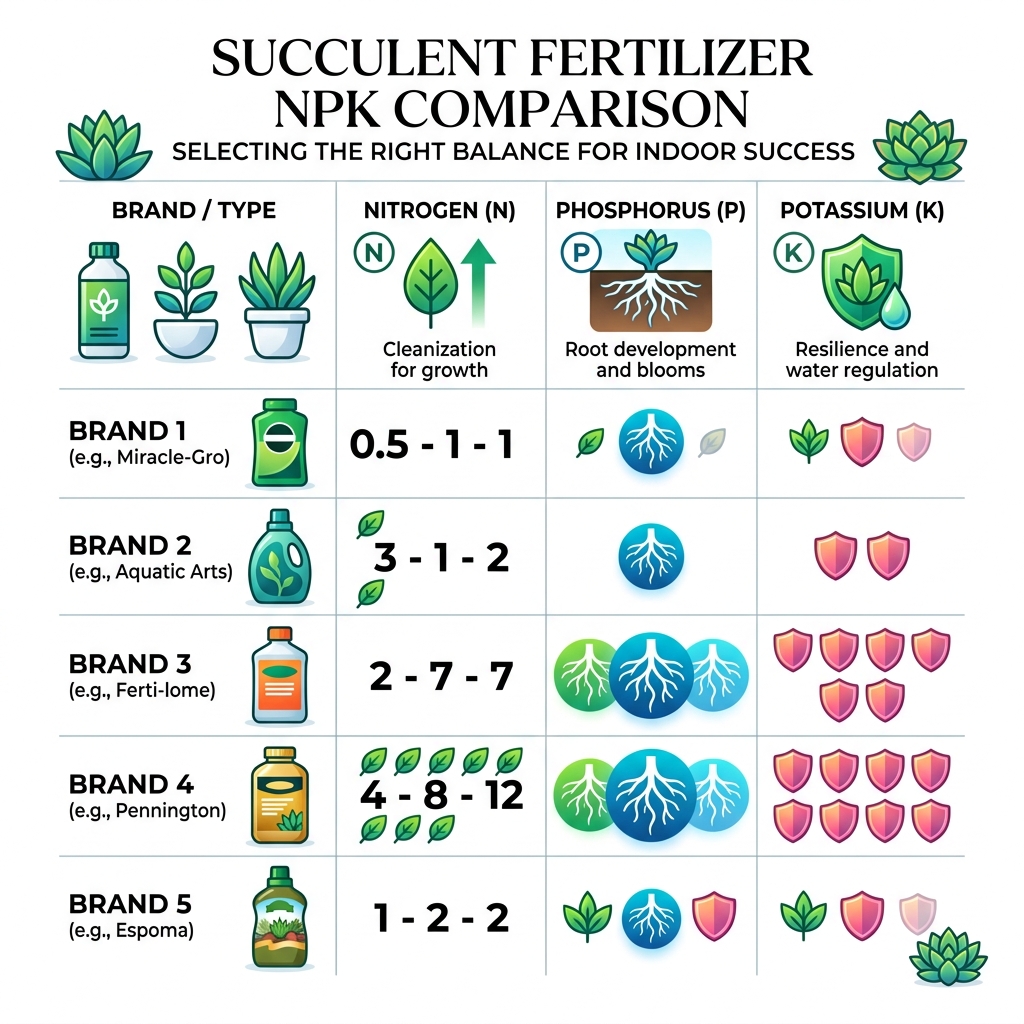
If you’ve ever looked at a fertilizer bottle, you’ve seen three numbers separated by dashes—like 2-7-7 or 3-1-2. This is the NPK ratio, representing Nitrogen (N), Phosphorus (P), and Potassium (K). For succulents, the balance of these three is critical.
- Nitrogen (N): This fuels leaf and stem growth. While essential, too much nitrogen is the enemy of a beautiful indoor succulent. It causes “leggy” growth, where the plant stretches out and becomes weak and pale.
- Phosphorus (P): This is the “root builder.” It helps plants establish a strong foundation and is vital if you want your succulents to eventually bloom. It also helps plants recover from issues like root rot.
- Potassium (K): Think of this as the immune system booster. It regulates water movement within the plant and strengthens the overall vigor.
For indoor plants, we generally look for a low-nitrogen formula. A ratio like 0.5-1-1 (found in Miracle-Gro) is excellent because it’s incredibly gentle. Others prefer a 2-7-7 ratio, like the one found in the Ferti-lome Succulent & Cactus Plant Food, which prioritizes root and structural health over leafy bulk.
Beyond N-P-K: Micronutrients and Calcium
While NPK are the “big three,” succulents also benefit from micronutrients like magnesium, sulfur, and iron. One “secret weapon” in the succulent world is calcium. Using a calcium supplement or a fertilizer that includes it helps create more rigid, vigorous cell walls. This makes the plant much more resistant to bacterial rot—a common killer of indoor plants.
Before you start a feeding regimen, make sure your plants are sitting in the best-soil-for-indoor-succulents. Fertilizer can’t fix the problems caused by heavy, compacted soil that doesn’t drain.
Top-Rated Commercial and Organic Feeding Options
When choosing a fertilizer for indoor succulents, you have two main paths: commercial (synthetic) or organic.
Commercial fertilizers are designed for instant gratification. They are often highly water-soluble, meaning the plant can drink up the nutrients the moment you pour them in. Organic options, on the other hand, often focus on building soil health and providing a slow, steady stream of nutrients through microbial activity.
Best Commercial Fertilizer for Indoor Succulents
If you want a “set it and forget it” approach, commercial liquids are usually the way to go.
- Miracle-Gro Succulent Plant Food (0.5-1-1): This is a favorite for beginners because it can be applied as a foam directly to the soil (1-2 pumps depending on pot size) or mixed with water (8 pumps per quart). It feeds instantly and is very hard to mess up.
- Aquatic Arts Succulent Fertilizer (3-1-2): This is a slightly “hotter” (stronger) formula but is still very gentle. It’s highly concentrated; an 8 oz bottle can last up to a year because you only use 1 tsp per 2 cups of water. Users often report seeing a deeper green color in their Aloe and Snake plants within weeks.
- Ferti-lome Succulent & Cactus Plant Food (2-7-7): This is a great choice for those who want to focus on flowering and root health. You can even use it every time you water if you dilute it to 1/8 tsp per quart.
- Pennington Full Season (4-8-12): This is a granular, slow-release option. It uses polymer-coated urea to release nitrogen slowly over 6 months. It’s perfect if you don’t want to remember a feeding schedule.
For safety information on these synthetic options, you can always check the scottsmsds.com Safety Data Sheets to see exactly what’s inside.
Organic Fertilizer for Indoor Succulents Alternatives
For those who prefer a natural approach, organic fertilizers are fantastic for long-term plant health. They often contain bio-stimulants that help the plant handle the stress of low-light indoor living.
- Seaweed/Kelp Extract: This is often called the “ultimate” succulent food. It is very low in NPK but packed with 60 trace elements and natural growth hormones like auxins and cytokinins. It helps plants stay compact and strong.
- Compost Tea: This is essentially “liquid gold” for plants. It’s full of beneficial microbes that break down organic matter in the soil. Scientific research on compost tea benefits shows it significantly improves root systems.
- Fish Emulsion: While it can be a bit smelly (though indoor versions are better), it is a classic organic choice. It provides a gentle nitrogen boost that won’t cause the dreaded “legginess.”
- Sustainable Options: Products like Dr. Earth Succulence (1-1-2) are made from upcycled food waste, making them an eco-friendly choice for your indoor garden.
If you’re wondering how these fit into a broader routine, check out our guide on how-to-fertilize-succulents-indoors.
Application and Troubleshooting for Low-Light Plants
The number one rule of fertilizing indoor succulents is: When in doubt, dilute.
In a low-light indoor environment, your plant is not “working out” as much as an outdoor plant. It doesn’t need a massive protein shake; it needs a light snack. If a bottle tells you to use a certain amount, we recommend starting with half that strength.
The Golden Rules of Application
- Never fertilize dry soil: This is a recipe for root burn. Always water your plant slightly first, or ensure the fertilizer is heavily diluted in your watering can.
- The 1/8 tsp Rule: If you want to feed every time you water, use a very weak dilution (about 1/8 tsp per quart of water). This provides a consistent, low-level nutrient flow.
- Seasonal Adjustments: Succulents generally have a growing season (Spring/Summer) and a dormant season (Fall/Winter). During dormancy, stop fertilizing entirely. Your plant is “sleeping” and cannot process the nutrients, which can lead to a toxic salt buildup in the soil.
Signs of Trouble
Monitoring your plant is the best way to tell if your feeding routine is working.
- Over-fertilization: Look for a white, crusty film on the soil surface (salt buildup) or yellowing, wilting leaves despite the soil being dry. In extreme cases, the roots will turn black or brown (root burn). If this happens, you may need to follow a repotting-indoor-succulents-step-by-step guide to give the plant fresh, clean soil.
- Under-fertilization: If your succulent hasn’t grown at all in a year, or if the new leaves are significantly smaller and paler than the old ones, it might be hungry.
- The “Leggy” Look: If your plant is stretching toward the light and looks “stretched out,” you might be giving it too much nitrogen or not enough light. Adjust your indoor-succulent-watering-schedule and feeding frequency accordingly.
Frequently Asked Questions about Fertilizer for Indoor Succulents
Do indoor succulents in low light actually need fertilizer?
Yes, but very little. Think of fertilizer as a supplement rather than a primary food source (which is light). Even in low light, the minerals in the potting soil will eventually deplete. A very diluted feeding once every 4-6 weeks during the spring is usually enough to keep them healthy without causing weak, spindly growth.
How often should I fertilize during the growing season?
For most indoor environments, once a month is the “sweet spot.” If you are using a very weak formula like Miracle-Gro (0.5-1-1), you can go as often as every two weeks. If you are using a stronger organic concentrate, stick to every 4-8 weeks. Always let the plant’s appearance be your guide.
Can fertilizer help my indoor succulents bloom?
It can! Blooms require a lot of energy. A fertilizer with a higher middle number (Phosphorus), like a 2-7-7 or 4-8-12, provides the specific nutrients needed for flower production. However, keep in mind that light is still the most important factor for blooming. Without enough “sun power,” the plant won’t have the energy to flower, no matter how much you feed it.
For a visual guide on the process, you can watch this VIDEO: How to Fertilize Succulents featuring expert tips on timing and technique.
Conclusion
At Finance Foxx, we believe that plant care shouldn’t feel like a chore or a chemistry experiment. Fertilizing your indoor succulents is simply about giving them the tools they need to stay resilient in an indoor environment.
The Beginner’s Checklist:
- DO use a low-nitrogen fertilizer to avoid “stretching.”
- DO dilute your fertilizer to half-strength or less.
- DO feed only during the active growing months (Spring and Summer).
- DON’T fertilize a plant that is already stressed, diseased, or bone-dry.
- DON’T overfeed; in succulents, less is almost always more.
By pairing the right fertilizer for indoor succulents with consistent watering and the best light you can provide, you’ll enjoy a vibrant, healthy indoor garden for years to come. For more tips on keeping your greenery in top shape, visit our Maintenance and Care Pillar Page.
