
Haworthia Care Tips for the Perfect Indoor Succulent
Why Haworthia Is the Perfect Low-Maintenance Indoor Plant
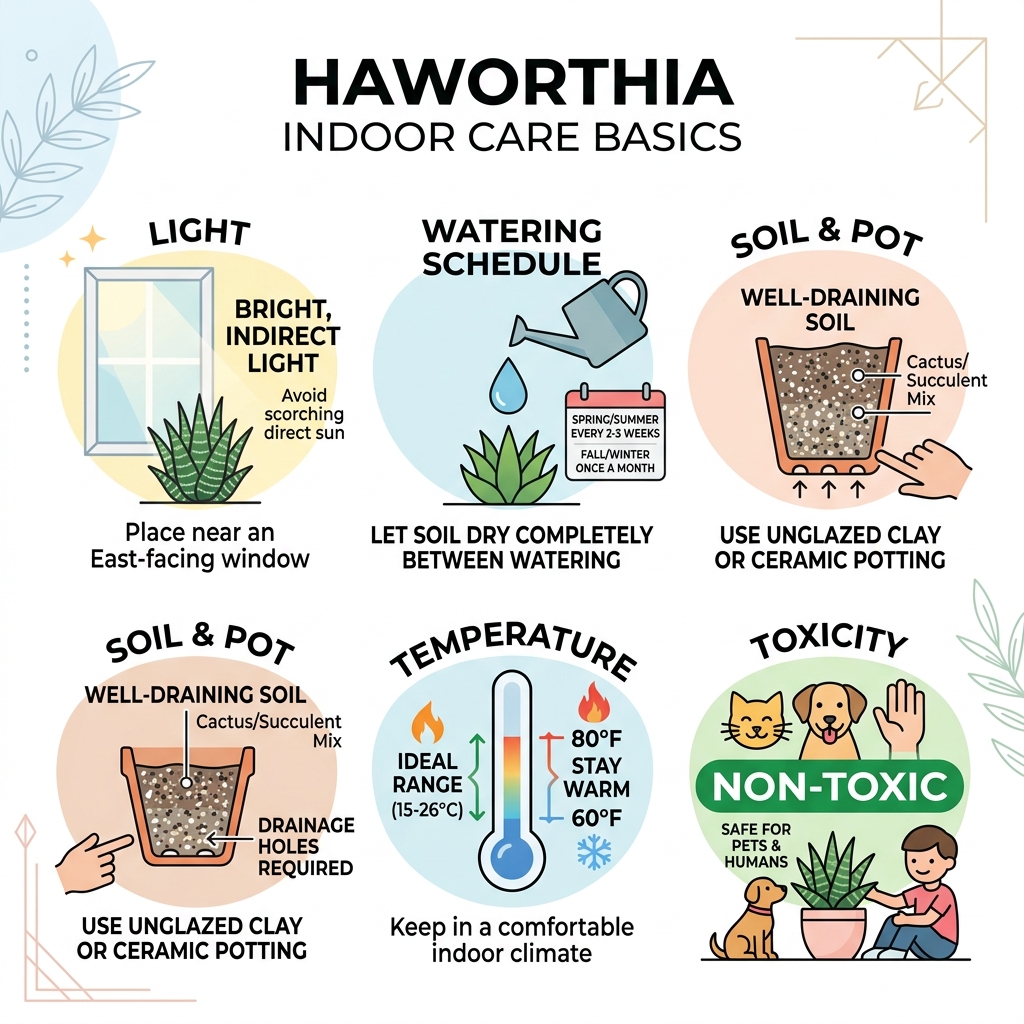
Haworthia indoor care is surprisingly simple — making it one of the best succulents for busy people who want beautiful plants without a lot of effort.
Here’s a quick overview of what your Haworthia needs:
| Care Factor | What to Do |
|---|---|
| Light | Bright, indirect light near an east-facing window |
| Watering | Every 2-3 weeks in spring/summer; once a month in fall/winter |
| Soil | Well-draining cactus or succulent mix |
| Pot | Unglazed clay or ceramic with drainage holes |
| Temperature | 60-80°F (15-26°C) indoors |
| Fertilizer | Once or twice during the growing season |
| Toxicity | Non-toxic to pets and humans |
Haworthia is a compact succulent native to Southern Africa. It belongs to the Asphodelaceae family and includes over 150 species — from the striped Zebra Plant (Haworthiopsis fasciata) to the ridged Fairy Washboard (Haworthia limifolia) and the translucent Cathedral Window (Haworthia cymbiformis).
Most varieties stay between 2 and 12 inches tall. That makes them ideal for small spaces like desks, shelves, and windowsills.
They’re slow growers, drought-tolerant, and much more forgiving than most houseplants. Even if you forget to water for a few weeks, they’ll likely be just fine.
In this guide, you’ll learn exactly how to keep your Haworthia thriving indoors — covering light, water, soil, feeding, propagation, and common problems.
Mastering Haworthia Indoor Care: Light, Water, and Soil
To truly master haworthia indoor care, we need to look at where these plants come from. Native to the rocky, arid regions of Southern Africa, these succulents are built for survival. They often grow tucked under the shade of larger rocks or bushes, which is why they are much more tolerant of indoor conditions than succulents that crave blistering, direct desert sun.
In our homes, Haworthia thrives when we mimic these “bright but protected” conditions. Generally, they prefer a temperature range between 60°F and 95°F. While they are hardy, they aren’t fans of the frost. If you live in a colder climate, indoor succulent care during winter becomes vital. During the colder months, these plants enter a semi-dormant state, meaning their metabolic processes slow down significantly.
Proper ventilation is another secret to success. In the wild, these plants deal with breezy cliffside or plains environments. Indoors, stagnant air can lead to moisture buildup, which invites pests and rot. Ensuring your plant isn’t shoved into a dark, airless corner will go a long way in keeping it happy.
Seasonal Watering Comparison
| Season | Frequency | Soil Condition Before Watering |
|---|---|---|
| Spring & Summer | Every 2-3 weeks | Top 1-2 inches completely dry |
| Fall & Winter | Every 4-6 weeks | Entire pot nearly bone-dry |
Optimal Lighting for Haworthia Indoor Care
One of the most common questions we hear is: “Does Haworthia need full sun?” The answer is a bit nuanced. While they love light, direct afternoon sun can actually scorch their fleshy leaves, turning them an angry red, purple, or even white/brown.
For the best results, place your plant near an east-facing window where it can soak up the gentle morning sun. If you only have south or west-facing windows, move the plant a few feet back from the glass or use a sheer curtain to filter the rays. Understanding the sunlight requirements for indoor succulents is the first step to preventing “etiolation”—that’s the fancy word for when a plant stretches out and looks “leggy” because it’s searching for more light.
If your home is naturally dark, don’t worry! You can use a grow light to provide the 6-8 hours of “brightness” they need. Just make sure the light is at least 24 inches away to avoid heat damage. For more in-depth tips, check out our guide on sunlight requirements for indoor succulents-2.
Best Soil and Pots for Haworthia Indoor Care
If there is one thing that will kill a Haworthia faster than anything else, it’s “wet feet.” These plants have thick, succulent roots designed to store water, but if those roots sit in soggy soil, they will rot within days.
The best soil for indoor succulents is a mix that prioritizes drainage. We recommend a high-quality cactus or succulent potting mix. You can make it even better by mixing in some perlite, pumice, or coarse sand. This creates air pockets in the soil, allowing the roots to breathe.
As for the container, your choice matters just as much as the dirt. We always suggest ceramic pots with drainage holes. Unglazed clay or terracotta pots are particularly excellent for haworthia indoor care because the porous material allows excess moisture to evaporate through the walls of the pot. Since Haworthia has a relatively shallow root system, you don’t need a deep “standard” pot; a shallow, wide container often works best. You can find more advice on picking the best pot for indoor succulents on our site.
Watering and Feeding Your Succulent
Watering is where most beginners get nervous, but the “soak and dry” method is your best friend. Instead of giving your plant a tiny sip every few days, give it a deep drink until water flows out of the drainage holes. Then—and this is the important part—wait until the soil is completely dry before watering again.
Following a consistent indoor-succulent-watering-schedule helps, but always trust your finger over a calendar. Stick your finger an inch into the soil; if you feel any moisture at all, walk away!
Be careful not to let water pool in the center of the rosette. This “crown rot” is a common way these plants meet an early end. To avoid this, water the soil directly at the base of the plant. If you’re worried about your technique, read up on indoor-succulent-watering-mistakes-to-avoid to stay on the safe side.
When it comes to feeding, Haworthia isn’t a hungry plant. During the active growing season (spring and summer), you can use a balanced, water-soluble fertilizer diluted to half or even quarter strength. Fertilizing once a month or even just twice a year is plenty. Over-fertilizing can lead to lanky growth or chemical burns on the roots. Learn the specifics of how to fertilize succulents indoors to ensure you’re giving them just enough “juice” to thrive.
Pro Tip: Want to see those tiny, star-shaped white flowers? While rare indoors, you can encourage blooming by providing slightly cooler temperatures in the winter (around 50-55°F) and ensuring the plant gets plenty of bright, indirect light during the spring.
Propagation and Repotting Techniques
One of the most rewarding parts of haworthia indoor care is how easily these plants “gift” you with babies. Most species produce “offsets” or “pups”—miniature versions of the parent plant that sprout around the base.
Pup Division
This is the easiest way to propagate. Once a pup is about one-third the size of the parent and has its own small roots, you can gently pull or cut it away with a sterilized knife. Let the “wound” callus over for a day or two in a dry spot, then tuck it into its own pot of succulent mix. For a detailed walkthrough, see our guide on how to propagate succulents indoors.
Other Methods
- Leaf Cuttings: This is possible but much slower and less reliable than offsets. You must ensure you get a “clean” pull that includes a bit of the stem tissue.
- Seed Propagation: For the patient gardener, seeds can be sown in a well-draining medium, though they require high humidity and consistent warmth to germinate.
- Coring: This involves removing the center of the parent plant to force it to produce more offsets at the base. It’s a bit drastic for beginners but very effective for collectors!
Repotting
You won’t need to repot often. Haworthia grows slowly and actually prefers being a little bit “snug” in its pot. Every 2 to 3 years is usually sufficient to refresh the soil. If you see roots bulging out of the drainage hole or if the plant has produced so many pups that it’s hitting the sides of the container, it’s time! The best time to repot is in the spring. Follow our repotting-indoor-succulents-step-by-step guide to make the transition stress-free for your plant.
Troubleshooting Common Haworthia Problems
Even the most resilient plants run into trouble sometimes. The key is to catch issues early.
Pests
The most common intruder is the mealybug—tiny, white, cottony-looking insects that hide in the crevices of the leaves. You can dab them away with a cotton swab dipped in rubbing alcohol. For larger infestations, neem oil or insecticidal soap are effective, non-toxic solutions.
Diseases
Root rot is the “silent killer.” If your plant’s leaves look yellow, translucent, or feel mushy at the base, you’ve likely overwatered. If the rot hasn’t reached the center, you can try to save it by removing the plant from the soil, cutting away the black/mushy roots, letting it dry out for a few days, and replanting in fresh, dry soil. In severe cases, a systemic fungicide might be necessary.
Physical Issues
- Etiolation: If your plant is stretching and losing its compact shape, it needs more light.
- Sunburn: White or brown crispy patches mean it’s getting too much direct sun.
- Yellowing Leaves: This can be a sign of overwatering or a nutrient deficiency. If the soil is dry, it might be time for a light feeding.
- Brown Tips: Usually a sign of underwatering or very low humidity.
Keeping your plant tidy by removing dead or dried-out leaves at the bottom of the rosette helps prevent pest hiding spots. Learn how to prune indoor succulents to keep your Haworthia looking its best.
Frequently Asked Questions about Haworthia
How often should I water my Haworthia indoors?
Generally, every 2-3 weeks during the spring and summer, and once a month during the winter. Always check that the soil is completely dry before adding more water. Factors like pot material (terracotta dries faster) and home humidity will affect this.
Can Haworthia grow in low light?
“Tolerate” is a better word than “grow.” While Haworthia is more shade-tolerant than an Echeveria or a Cactus, it still needs bright, indirect light to maintain its vibrant colors and tight rosette shape. In true low light, it will stretch out and become weak.
Is Haworthia toxic to cats and dogs?
Good news for pet parents! According to the ASPCA Zebra Succulent Care guide, Haworthia is non-toxic to cats, dogs, and even horses. While we don’t recommend letting your cat use it as a snack, it won’t cause serious harm if they take a curious nibble.
Conclusion
At Finance Foxx, we believe that bringing nature indoors shouldn’t be a source of stress. Haworthia indoor care offers the perfect balance of architectural beauty and “set it and forget it” resilience. Whether you’re a seasoned collector or a first-time plant parent, these South African gems are a fantastic investment for your home environment.
By providing bright indirect light, using well-draining soil, and resisting the urge to overwater, you’ll have a thriving succulent that can live for decades. If you’re just starting your journey, be sure to check out our indoor-succulent-care-tips-for-beginners/ for more foundational advice.
Ready to expand your indoor garden or need help keeping your current collection in top shape? More info about maintenance services is available on our site to help you grow your green thumb with confidence!
